Standard forms
Verse, chorus, break — and the predictability that makes joining in possible.

Verse, chorus, break, repeat. Predictability is what lets a player join a tune they have never played.
The predictability that makes joining in possible.
The skeleton everyone shares
A bluegrass song tends to follow a skeleton so familiar that a player hearing it for the first time can anticipate almost every joint. Verses carry the story; a chorus, if there is one, resolves it on the same words each time. Somewhere in the middle — or between verses — an instrument takes a break, playing the melody or improvising over the chord changes while the singers rest. Then the vocal comes back and the pattern repeats.

The chairs face inward because the circle, not a stage, decides who plays next.
Photo: K / PexelsThat three-part logic — verse, chorus, instrumental break — is not accidental. It grew from string-band and country gospel conventions, and it survived because it is legible. A fiddle player who has never heard this particular song can still count in and know roughly where the break will land, roughly how long it will run, and exactly when to hand back to the voice. The form is the contract.
Most breaks run one full verse length over the same chord progression the singer just used. The banjo takes it, or the fiddle, or the mandolin; rarely more than one instrument per break unless a tune is being stretched for a radio slot or a live showcase. Because the mix is made by walkingin and out from the microphone, stepping forward to take a break is also a physical act — the player moves toward the microphone, plays, and steps back. The form and the movement are the same thing.
Choruses are not universal. Plenty of bluegrass songs are through-composed in everything but name — a chain of verses with a tag line that recurs but no true fixed chorus. What stays constant is the verse length and the chord sequence underneath it, usually three or four chords cycling at a tempo that does not drift. Players in a circle can drop in because the harmonic map never changes.
This is why standard form matters less as style and more as infrastructure. The song is the occasion; the form is the road it runs on, worn smooth enough that everyone already knows the way.
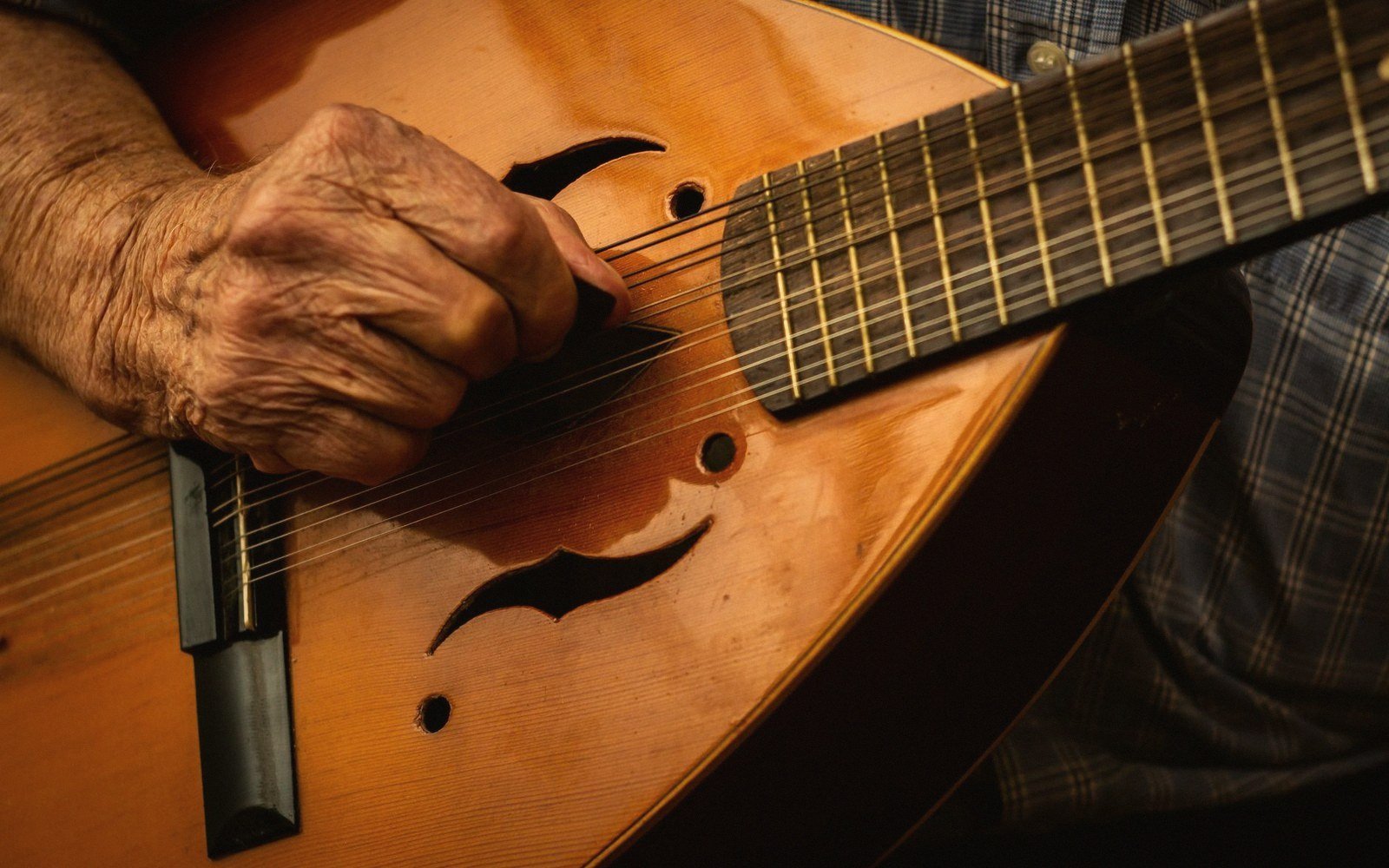
The mandolin’s short, damped chord does the work a snare drum does elsewhere.
Photo: Marcelo Renda / PexelsFiled in The Repertoire