
One stand and one cable will play a hall, a flatbed trailer, or a room with no PA at all.
A practical constraint that became an aesthetic and then a tradition.
The accident that stuck
The single microphone was not a philosophy. It was what broadcasters had in the 1940s, what the Grand Ole Opry stage offered, what a band could afford to carry. Bill Monroe and his Blue Grass Boys stepped up to RCA ribbon mics because that was the equipment in the room. They arranged themselves to sound good through it. And then they kept doing it long after better options existed.
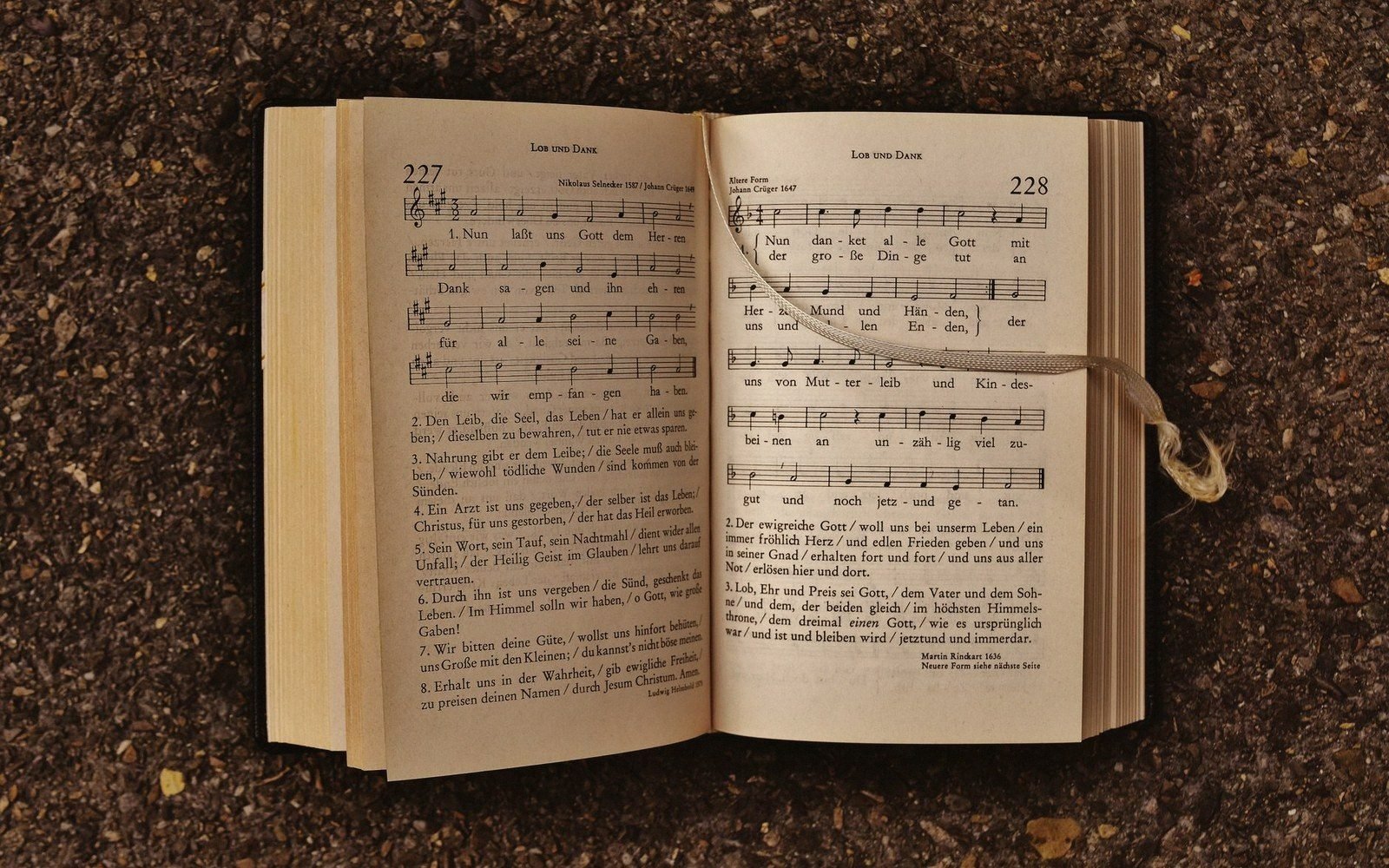
Printed collections record the repertoire. They do not define it.
Photo: Pixabay / PexelsThat is the whole story, in one sense. But the single-mic arrangement turned out to encode something that proved impossible to abandon without losing the music itself.
When a band shares one microphone, the mix is made by the players. Whoever steps forward is louder. Whoever holds still stays in the blend. The relationship between instruments is not a decision made afterward by a dial — it is a live, physical negotiation happening in real time. That relationship is what listeners hear, whether or not they can name it. The transparency is the point: you can hear exactly where the mandolin chop sits against the banjo roll, exactly how far the tenor stands from the lead. The spatial information is genuine.
Close-micking changed what was possible in a studio. Individual instruments could be isolated, balanced, fixed. Some bands adopted it. But the editing that isolation made available also removed the constraint that had generated the aesthetic, and what came back from the mix was not quite the same thing. The motion, the lean, the slight swell as a soloist steps in — these do not survive separation and recombination intact.
So the tradition continued in parallel. Recording dates still happened around a single mic. Jam circles never had any other option. The car park jam at any festival runs exactly as the Opry stage ran: one space, all sounds competing, everyone adjusting. Players who grew up in those circles brought the same physics to the stage. The constraint trained the ear.

A stage set for one microphone: the marks on the floor are the arrangement.
Photo: Wendy Wei / PexelsWhat survived is not nostalgia. It is a working arrangement that produces a sound — coherent, unmediated, readable by anyone listening — that other arrangements do not produce. The accident turned into an aesthetic because the aesthetic was real. The tradition followed because abandoning it meant losing something specific. That sequence — constraint, discovery, commitment — is how most musical traditions actually start.
Filed in The Mic